Tamarix
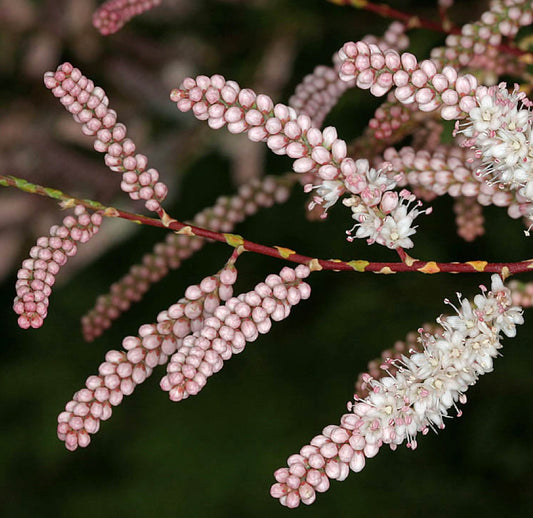
Tamarix defines a genus of deciduous coastal shrubs native to Mediterranean and Eurasian regions, where saline soils and strong winds shape light, flexible forms. Tamarix gallica develops slender branches and fine feathery foliage that reduce resistance to salt spray and heat. From spring to summer, soft pink flower plumes appear along the shoots, adding seasonal translucence. As a salt-tolerant woody plant adapted to dry sandy soils and exposed sites, this genus expresses resilience through openness, movement, and atmospheric presence.
-
Tamarix gallica 15-50cm | French Tamarisk
Regular price €13,00Regular priceUnit price / perSale price €13,00 -
Tamarix africana 50-100cm | African tamarisk | Salt cedar
Regular price €14,00Regular priceUnit price / perSale price €14,00 -
Tamarix africana 15-25cm | African tamarisk | Salt cedar
Regular price €6,10Regular priceUnit price / perSale price €6,10Sold out -
Tamarix ramosissima 40-80cm | Saltcedar | Tamarisk
Regular price €80,00Regular priceUnit price / perSale price €80,00 -
Tamarix ramosissima 15-35cm | Saltcedar | Tamarisk
Regular price €70,00Regular priceUnit price / perSale price €70,00 -
Tamarix tetrandra 40-80cm | Four-stamen tamarisk | Tamarisk
Regular price €80,00Regular priceUnit price / perSale price €80,00Sold out -
Tamarix tetrandra 15-35cm | Four-stamen tamarisk | Small tamarisk
Regular price €70,00Regular priceUnit price / perSale price €70,00Sold out -
Tamarix gallica 80-110cm | French tamarisk | Salt cedar
Regular price €36,00Regular priceUnit price / perSale price €36,00Sold out
Tamarix – Airy forms shaped by salt and wind
Botanical identity and origin
Native to Mediterranean and Eurasian origin, Tamarix develops as a deciduous coastal shrub adapted to saline conditions and open exposure. Species such as tamarix gallica, often called the salt cedar shrub, inhabit coastal and riparian habitats where wind and mineral soils dominate. Growth is defined by slender flexible branches and fine feathery foliage, reducing resistance to wind and salt spray. Within these environments, Tamarix evolved resilience through light structure and physiological tolerance.
Species identity and ornamental resonance
Diversity within Tamarix is expressed through stature and flowering density rather than foliage variation. During spring to summer flowering, shrubs produce pink flower plumes that soften the plant’s airy framework. Flowers are numerous but delicate, forming translucent veils rather than solid masses. Visual identity arises from movement and texture, with blooms accentuating branch lines rather than obscuring them. This quality defines Tamarix as a plant of atmosphere rather than solidity.
Cultivation and ecological adaptability
In cultivation, Tamarix thrives in dry sandy soils and tolerates extreme exposure. Its identity as a salt-tolerant woody plant allows establishment where few shrubs persist. Minimal irrigation and full sun support long-term health, while pruning maintains balance without altering natural form.
-
Branches bending freely under coastal winds
-
Foliage maintaining lightness through heat
-
Flowers emerging in airy seasonal waves
-
Structure remaining open and permeable
Poetic synthesis and botanical meaning
Ultimately, Tamarix conveys a poetics of lightness and endurance. Through tamarix gallica, the genus embodies landscapes where wind, salt, and scarcity define form. Its feathery foliage, transient flowers, and flexible structure render Tamarix a botanical emblem of resilience expressed through delicacy, shaped by exposure, movement, and open space.
Collections
-
Books & Readings
Books and Readings: Discover the World of Plants Through Pages Why Read...