Olive Trees
Olive Trees span forms such as olea europaea, olea europaea arbequina, olea europaea koroneiki, olea europaea frantoio, and olea europaea leccino, all defined by narrow silvery foliage, gnarled trunk architecture, and a drought-adapted evergreen habit. Rooted in Mediterranean dryland habitat, they express slow-growth sculptural form, aromatic fruiting cycle, and wind-shaped canopy structure, embodying luminous resilience across arid landscapes.
-
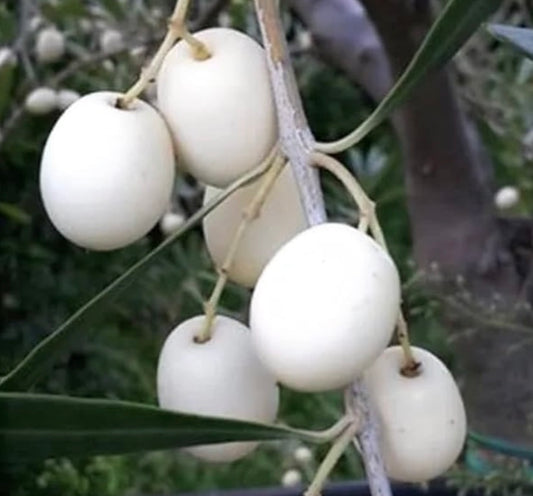
Olea europaea var. leucocarpa 30-50cm | White Olive | Ghost Olive
Regular price €25,00Regular priceUnit price / perSale price €25,00Sold out -
Olea europea cv KAMALATA (Greek cultivar) 35-70cm | Greek Olea | Kamalata's Olive Tree
Regular price €42,00Regular priceUnit price / perSale price €42,00 -
Olea europaea cv 'Nocellara' 60-80cm | Olive tree | European olive
Regular price €29,70Regular priceUnit price / perSale price €29,70 -
Olea europaea cv 'Nocellara' 90-140cm | Olive tree | European olive
Regular price €54,00Regular priceUnit price / perSale price €54,00 -
Olea europaea var. leucocarpa 90-110cm | White olive | Leucocarpa olive
Regular price €70,00Regular priceUnit price / perSale price €70,00 -
Olea europea cv CORATINA 35-70cm | Olive | European olive
Regular price €38,00Regular priceUnit price / perSale price €38,00 -
Olea europea cv MONOPOLI 35-70cm | Olive tree | European Olive
Regular price €42,00Regular priceUnit price / perSale price €42,00 -
Olea europea cv MORATINA 35-70cm | Olive tree | European olive
Regular price €39,00Regular priceUnit price / perSale price €39,00
Olive Trees – The silver-borne sentinels of Mediterranean light
Botanical identity and origin
Within Oleaceae, Olive Trees arise from Mediterranean dryland habitat, where drought, calcareous soils, and maritime winds sculpt their physiology. Defined by narrow silvery foliage, gnarled trunk architecture, and a drought-adapted evergreen habit, these trees evolved to balance luminous exposure with minimal water loss. Species such as olea europaea exemplify this equilibrium between resilience and refinement. Across coastal slopes and inland terraces, Olive Trees articulate a botanical lineage shaped by sunlight, salinity, and slow geomorphological rhythms.
Species diversity and ornamental resonance
The diversity of Olive Trees spans cultivars such as olea europaea arbequina, noted for compact habit and early fruiting, and olea europaea koroneiki, with fine foliage and dense branching. Meanwhile, olea europaea frantoio and olea europaea leccino offer contrasting canopies and rich aromatic profiles. Across these forms, Olive Trees reveal slow-growth sculptural form, where bark fissures deepen over decades. Their fruits embody an aromatic fruiting cycle that mirrors climatic fluctuations, rendering each tree a subtle chronicle of environment and time.
Cultivation and landscape adaptability
In cultivation, Olive Trees prefer well-drained mineral soils, full sun, and irrigation aligned with arid-season dormancy. Species such as olea europaea arbequina adapt well to varied exposures, while wind-shaped canopy structure allows Olive Trees to integrate seamlessly into coastal or elevated designs. Their longevity, modest growth, and persistent foliage make them stabilizing elements in Mediterranean-inspired landscapes.
-
Silvery leaves diffusing high-angle sunlight
-
Twisted trunks archiving decades of seasonal stress
-
Branches forming airy, permeable canopies
-
Fruiting rhythms punctuating annual cycles
Symbolic synthesis and aesthetic meaning
Ultimately, Olive Trees embody a synthesis of endurance and luminosity. Through species such as olea europaea koroneiki and olea europaea leccino, the genus expresses a quiet strength rooted in stone, drought, and wind. Their gnarled trunk architecture and shimmering leaves evoke a poetics of longevity, making Olive Trees an emblem of Mediterranean clarity and contemplative resilience.
Collections
-
Books & Readings
Books and Readings: Discover the World of Plants Through Pages Why Read...