Olea
Olea spans species such as olea europaea, olea europaea sylvestris, olea capensis, olea paniculata, olea lancea, olea tsoongii, and olea woodiana, defined by narrow evergreen foliage, gnarled bark texture, and affinities for Mediterranean dryland habitat. With oil-rich drupe structure and slow-growing arboreal form, Olea embodies endurance and silvery luminosity across warm, drought-shaped environments.
-
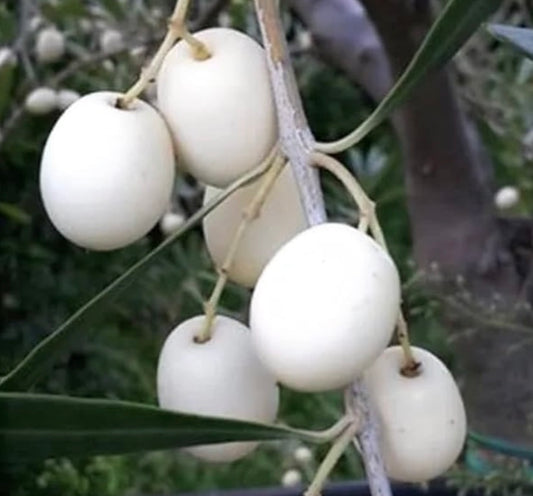
Olea europaea var. leucocarpa 30-50cm | White Olive | Ghost Olive
Regular price €25,00Regular priceUnit price / perSale price €25,00Sold out -
Olea europea cv KAMALATA (Greek cultivar) 35-70cm | Greek Olea | Kamalata's Olive Tree
Regular price €42,00Regular priceUnit price / perSale price €42,00 -
Olea europaea cv 'Nocellara' 60-80cm | Olive tree | European olive
Regular price €29,70Regular priceUnit price / perSale price €29,70 -
Olea europaea cv 'Nocellara' 90-140cm | Olive tree | European olive
Regular price €54,00Regular priceUnit price / perSale price €54,00 -
Olea europaea var. leucocarpa 90-110cm | White olive | Leucocarpa olive
Regular price €70,00Regular priceUnit price / perSale price €70,00 -
Olea europea cv CORATINA 35-70cm | Olive | European olive
Regular price €38,00Regular priceUnit price / perSale price €38,00 -
Olea europea cv MONOPOLI 35-70cm | Olive tree | European Olive
Regular price €42,00Regular priceUnit price / perSale price €42,00 -
Olea europea cv MORATINA 35-70cm | Olive tree | European olive
Regular price €39,00Regular priceUnit price / perSale price €39,00
Olea – The evergreen anatomies of Mediterranean endurance
Botanical identity and origin
Belonging to Oleaceae, Olea spans Mediterranean dryland habitat, African woodlands, and pockets of subtropical Asia, where drought, salinity, and intense sunlight shape its physiology. Defined by narrow evergreen foliage, gnarled bark texture, and an oil-rich drupe structure, the genus displays a robust adaptive identity. Species such as olea europaea articulate this harmony between aridity and longevity, while Olea overall reveals a lineage guided by slow growth and finely tuned water-use strategies across demanding terrains.
Species diversity and ornamental resonance
The diversity of Olea extends from the wild progenitor olea europaea sylvestris, with compact crowns and sharper foliage, to southern African species like olea capensis, marked by variable leaf forms. Meanwhile, olea paniculata and olea lancea demonstrate broader tropical tolerance, while olea tsoongii and olea woodiana emphasize finer venation and different fruiting rhythms. Across these expressions, Olea maintains a sculptural subtlety rooted in slow-growing arboreal form, merging structural endurance with muted chromatic shifts.
Cultivation and landscape adaptability
In cultivation, Olea prefers well-drained mineral soils, full sunlight, and irrigation calibrated to seasonal dryness. Species such as olea europaea adapt readily to warm exposures, while Mediterranean dryland habitat analogues enhance trunk formation and leaf density. The gnarled bark texture of mature specimens stabilizes compositions in coastal or elevated landscapes where light, wind, and heat contour their silhouettes.
-
Evergreen crowns diffusing high-angle brightness
-
Bark fissures tracing decades of climatic pressure
-
Silvery leaves shimmering against arid backdrops
-
Slow expansion reinforcing spatial rhythm
Symbolic synthesis and aesthetic meaning
Ultimately, Olea embodies a poetics of longevity, where oil-rich drupe structure and persistent foliage converge in a dialogue of endurance and luminosity. Through species such as olea capensis and olea paniculata, the genus expresses a continuity rooted in stone, wind, and seasonal austerity. In its sculptural restraint and quiet radiance, Olea stands as a botanical emblem of resilience shaped by ancient landscapes.
Collections
-
Books & Readings
Books and Readings: Discover the World of Plants Through Pages Why Read...