Jacaranda – The violet canopies of subtropical light
Botanical identity and origin
Native to South American subtropical habitat, Jacaranda forms airy trees marked by fern-like jacaranda foliage and finely divided leaflets that respond delicately to shifting light. The iconic jacaranda mimosifolia tree expresses smooth bark, upright branching, and a broad spreading canopy form. Through warm seasons and episodic dryness, Jacaranda regulates growth with seasonal jacaranda leaf drop, focusing energy on root expansion and timely flowering cycles. Its presence in forest margins and open savannas ties the genus to climates defined by sun, wind, and rhythmic precipitation.
Species diversity and ornamental resonance
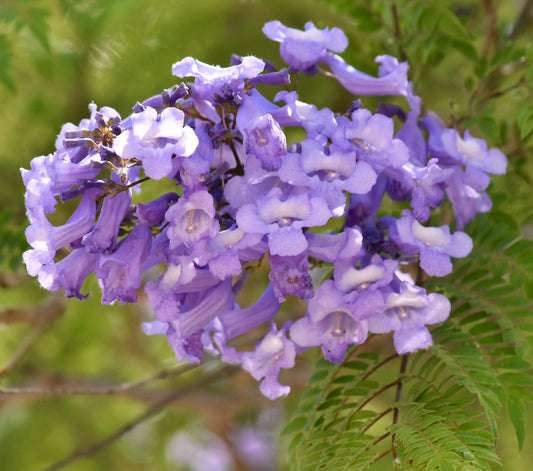
Diversity within Jacaranda centers on bloom color, canopy shape, and foliar finesse. Blue jacaranda tree forms display the well-known lavender-blue hues, while purple jacaranda tree selections deepen chromatic saturation. Ornamental expressions such as pink jacaranda bloom form highlight occasional deviations in pigment pathways. Across urban boulevards, jacaranda trees create sweeping carpets of violet through jacaranda purple flowers and late-spring jacaranda flowering, uniting architectural silhouettes with luminous floral density.
Cultivation and landscape adaptability
In cultivation, Jacaranda thrives in warm climates, well-drained soils, और exposures that amplify both foliage and bloom. The jacarandá tree responds well to generous light, producing open crowns that suit parks, avenues, and residential landscapes. Flowering intensity varies with temperature and dryness, while root systems stabilize through expanded surface zones.
-
Petals drifting across early summer pathways
-
Leaves softening glare with fine divisions
-
Branches forming airy, ascending structures
-
Seasonal rhythms mapping shaded ground patterns
Symbolic synthesis and aesthetic meaning
Ultimately, Jacaranda embodies a poetics of radiance and spatial openness. Through forms such as purple jacaranda tree and jacaranda mimosifolia tree, the genus expresses atmospheric depth shaped by light and season. In its violet drifts and sculptural canopy, Jacaranda stands as a botanical emblem of subtropical brilliance and gentle architectural presence.