Fockea – The caudiciform climbers of southern drylands
Botanical identity and origin
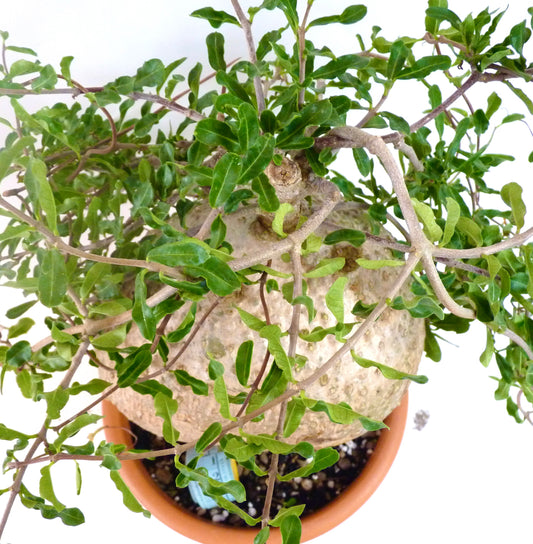
Rooted in semi-arid southern Africa habitat, Fockea forms a distinctive lineage of caudiciform succulent plant species adapted to oscillations of drought and seasonal rain. Defined by a swollen basal caudex, twining stems, and fine textural leaves, the genus modulates water storage through tuberous water-storage organs that stabilize growth across erratic climates. Species such as fockea edulis exemplify an evolutionary strategy in which subterranean mass and aerial delicacy coexist, allowing Fockea to persist within rocky, well-drained soils.
Species diversity and ornamental resonance
Within Fockea, diversity unfolds through structural variations: fockea crispa, with its undulating leaf margins, fockea angustifolia, marked by slender foliage, and fockea capensis, known for robust caudex formation. Rare taxa like fockea comaru widen the genus’s ecological spectrum. Across these forms, Fockea sustains a vining growth habit, producing twining green stems that contrast with the grounded solidity of the caudex. This interplay of weight and lightness creates a botanical vocabulary centered on resilience and sculptural proportion.
Cultivation and landscape adaptability
In cultivation, Fockea thrives in porous mineral soils, bright exposures, and controlled irrigation that mirrors its semi-arid southern Africa habitat. Warmth during active growth supports stem elongation, while the woody caudex architecture matures slowly with time. Such forms integrate naturally into xeric collections, caudiciform displays, and rock gardens where detail and structure guide the observer’s eye.
-
Caudex surfaces marked by subtle fissures
-
Vines casting delicate shadows on warm stone
-
Leaves responding to seasonal hydration pulses
-
Slow maturity reinforcing sculptural clarity
Symbolic synthesis and aesthetic meaning
Ultimately, Fockea conveys a poetics of grounded endurance and aerial mobility. Through species such as fockea crispa and fockea angustifolia, the genus expresses a dialogue between permanent subterranean strength and exploratory growth above ground. In its hybrid architecture—half root, half vine—Fockea becomes an emblem of adaptability shaped by scarcity, rhythm, and desert light.